
Crypto Staking 2026: What Is Staking and How to Stake Crypto | WEEX Guide


What Is Crypto Staking?
If you've been holding crypto and wondering how to make your assets work harder, you've probably heard about staking crypto. But what is crypto staking, really? In simple terms, staking means locking up your digital assets to support a blockchain network in exchange for rewards. Think of it like putting money in a savings account—except instead of a bank paying you interest, the network pays you for helping keep it secure.
Crypto staking has become one of the most popular ways for investors to earn passive income. Instead of letting your tokens sit idle, you can put them to work generating regular returns. Whether you're holding Bitcoin, Ethereum, or other proof-of-stake assets, there's likely a way to stake them.
But here's the thing: staking crypto isn't magic. It involves real mechanics, real risks, and real decisions. This guide breaks down how to stake crypto, what affects your rewards, and how platforms like WEEX make it accessible for everyday users.
How Does Staking Crypto Work?
To understand how staking crypto works, you need to know about proof of stake. Networks like Ethereum and Solana use this system—validators are chosen to confirm transactions based on how many tokens they hold and lock up as stake.
When you stake crypto, you commit your tokens to help secure the network. In return, you earn rewards—usually more tokens. Simple version: lock tokens, support the network, earn rewards.
You can stake directly on a blockchain (which requires technical know-how) or through an exchange like WEEX, which handles everything for you.
Staking Crypto Examples: How Rewards Actually Work
Let's look at some staking crypto examples to make this real. With a blockchain offering 5% annual rewards, staking 1,000 tokens could earn you about 50 tokens over a year, distributed daily or weekly.
Exchange-based staking on platforms like WEEX simplifies things—you deposit tokens, they handle the validators, and you receive a clear APR. No technical know-how needed.
You'll find two main options: flexible staking (withdraw anytime, lower rewards) and fixed staking (lock for 30–60 days, higher potential returns).
When evaluating staking, consider reward rates, lock-up periods, token volatility, and platform trust. Smaller tokens offer higher risk and potential; established assets like Bitcoin provide more stability through Bitcoin staking products.
What Is Bitcoin Staking? Can You Stake BTC?
Here's a question people ask all the time: can you stake Bitcoin? Bitcoin itself doesn't use proof of stake—it's a proof-of-work network. But that doesn't mean you can't earn yield on your BTC.
Platforms like WEEX offer innovative products that let you earn rewards on Bitcoin through structured staking programs. These aren't traditional staking in the pure blockchain sense, but they allow you to put your BTC to work generating passive income.
Bitcoin staking typically involves:
- Locking your BTC in a platform-managed program
- Earning rewards in BTC or other tokens
- Maintaining flexibility with different term options
If you're holding Bitcoin and want to earn yield, WEEX Staking provides a secure, straightforward way to do it—without needing to understand the technical complexities of blockchain validation.
Why Choose WEEX for Staking Crypto?
WEEX Staking makes crypto staking accessible to everyone—not just tech-savvy validators. Here's why it stands out:
Simple and Accessible
No nodes, no complex mechanics. With WEEX Staking, you start earning in minutes. Just deposit, choose your option, and let the platform handle the rest.
Flexible Options
Choose what fits your strategy: flexible staking for quick access, or fixed-term for higher potential APR.
Competitive Rates
WEEX offers transparent APRs across multiple assets—from Bitcoin to USDC. No hidden fees.
Institutional-Grade Security
Your assets are protected by cold storage, insurance funds, and regulatory compliance. WEEX is a trusted exchange with millions of users.
One-Click Staking
Funds in your account? Staking takes seconds. No transfers, no confusion. Just click and earn.
How to Stake Crypto on WEEX: Step-by-Step
Ready to start staking crypto? Here's how to stake on WEEX in four simple steps:
Ready to turn your crypto into an income stream? Follow these simple steps:
Step 1: Go to WEEX official website. Tap "Earn" and then select "Staking"
Step 2: Choose Bitcoin(BTC) and enter the amount.
Step 3: Select the funding source and double-confirm.
Step 4: You have finished the subscription successfully.
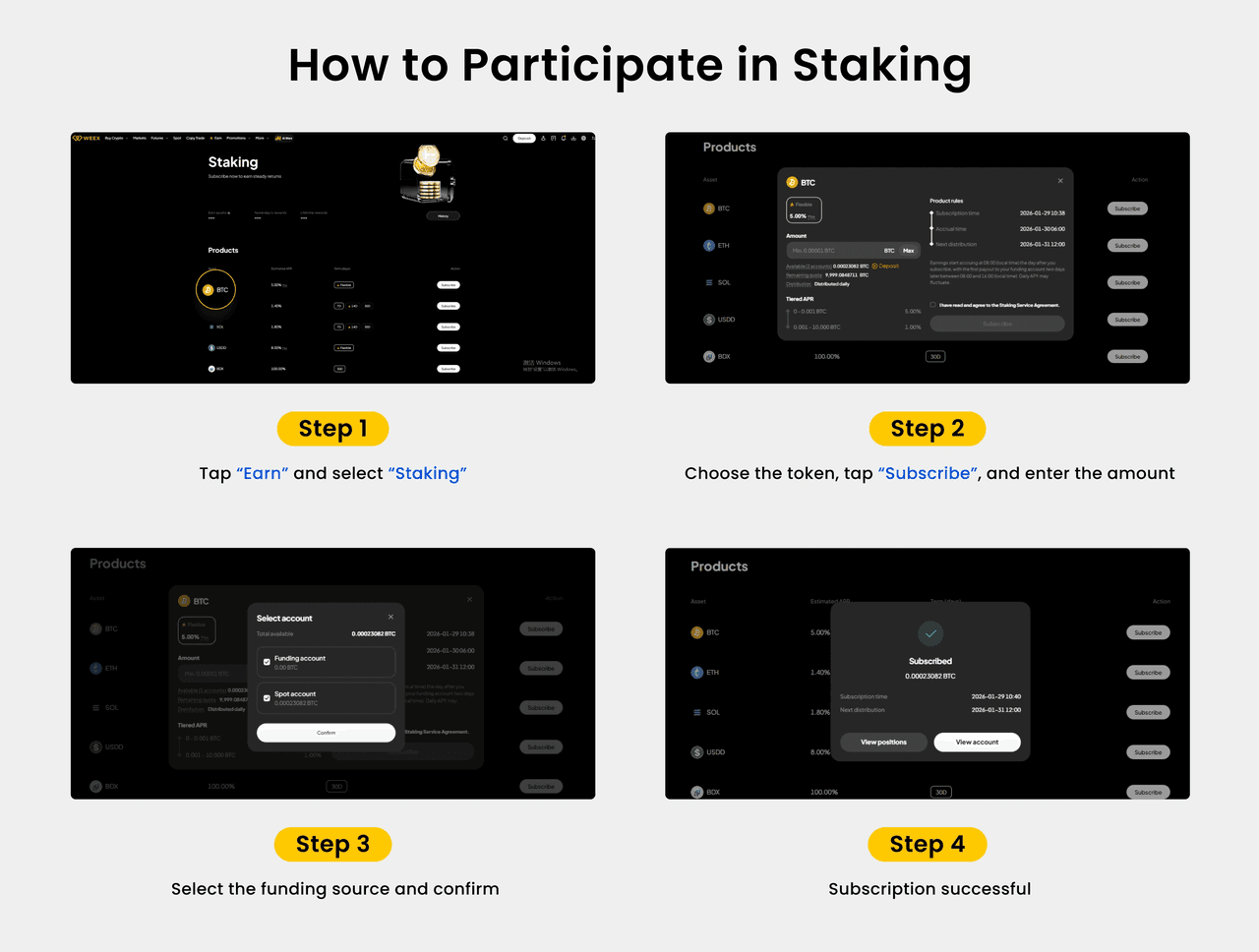
That's it. No technical knowledge required. No validator setup. Just simple, secure staking through WEEX.
Final Thoughts: Start Staking Crypto on WEEX Today
Staking crypto lets you earn passive income on assets you already hold. Whether you're a long-term Bitcoin holder or exploring new tokens, putting idle assets to work just makes sense in 2026.
WEEX Staking keeps it simple—no technical headaches, no confusing interfaces. Just straightforward options, competitive rates, and the peace of mind that comes with a trusted platform.
Ready to start earning? Register on WEEX today and put your crypto to work.Register on WEEX Now and Start Staking!
FAQ
Q1: What is crypto staking in simple terms?
A: Crypto staking means locking your tokens to support a blockchain network in exchange for rewards. It's like earning interest on your crypto.
Q2: How does staking crypto work?
A: You commit tokens to help validate transactions. The network rewards you with more tokens. Platforms like WEEX handle the technical side so you just earn.
Q3: Can I stake Bitcoin?
A: Bitcoin itself doesn't use proof of stake, but WEEX offers Bitcoin staking products that let you earn rewards on your BTC through structured programs.
Q4: What's the difference between flexible and fixed staking?
A: Flexible staking lets you withdraw anytime with lower rewards. Fixed staking locks funds for a set period but typically offers higher APRs.
Q5: Is staking crypto safe?
A: Staking carries risks—price volatility, lock-up periods, and platform risk. But staking through a trusted exchange like WEEX with strong security measures reduces many of these concerns.
Q6: How much can I earn staking crypto?
A: Rewards vary by token and term. Check WEEX Staking pages for current APRs on Bitcoin, Ethereum, USDC, and other assets.
Q7: How do I start staking on WEEX?
A: Create an account, deposit funds, go to the Staking section, choose your asset and term, and confirm. That's it.
Q8: Can I unstake early?
A: With flexible staking, yes. With fixed-term, early unstaking may forfeit earned rewards. Always check terms before committing.
Q9: What tokens can I stake on WEEX?
A: WEEX Staking supports multiple assets including Bitcoin, Ethereum, Solana, USDC, and more. Check the platform for the full list.
Q10: Is staking better than trading?
A: They serve different purposes. Staking generates passive income; trading seeks active profits. Many investors do both.
You may also like

What Is SAOS? Strategic American Oil Supply Token Explained
SAOS is a meme token on Solana with a 75,000 USD market cap and 22,000 USD locked liquidity, positioned around oil supply themes but lacking real asset backing
It thrives on pure narrative speculation, with no utility, website, or doxxed team, making it highly volatile and attention-dependent
Traders should distinguish SAOS from legitimate real-world asset projects, as its branding is speculative rather than substantive
Positive aspects include locked liquidity reducing rug pull risks, but low trading activity signals high uncertainty
How to Buy Public Asset Control (PAC) Token in 2026: Latest Solana Buying Guide
How to buy Public Asset Control (PAC) token in 2026, PAC contract address, Solana wallet setup, Jupiter swap guide, latest price, liquidity, and risks.

What Is Public Asset Control (PAC) Token and How Does It Work? Latest Solana PAC Token Guide
Public Asset Control (PAC) token explained. Learn what PAC is, how it works on Solana, current price snapshot, risks, and buying basics.
Can PAC Coin Reach $1 Soon? Analyzing Public Asset Control
PAC is a Solana-based meme token with a government-themed narrative, but it is highly speculative.
At its current price (~$0.0009) and 1B supply, reaching $1 would require a $1B market cap, which is very unlikely.
Short-term moves to $0.001 or $0.01 are more realistic, but the token is highly volatile due to low liquidity and hype-driven trading.
Overall, $1 is not a realistic target, and PAC is better suited for short-term speculation than long-term investment.
United Nations Oil Reserve (UNOS) Crypto: Solana Token, UN Links, and Risks
United Nations Oil Reserve (UNOS) Crypto explained: Solana token basics, UN links, oil-backing claims, market risks, contract checks, and buying cautions.

What Is Public Asset Control (PAC) Coin? Explained for Beginners
Public Asset Control (PAC) is a Solana-based token that uses a “government asset control” narrative involving oil and gold themes, but it has no verified ties to any real institutions or governments. It is mainly an entertainment-focused, speculative meme coin.
The project’s claims about links to entities like BlackRock or Palantir are unverified, and its own disclaimer states it is not a real financial or institutional asset. Like many new Solana tokens, PAC is highly volatile, with low liquidity and limited transparency, including no fully verified audit.
Overall, PAC is a high-risk speculative token driven by hype and storytelling rather than real utility. Beginners are advised to be cautious, verify contract details, and prioritize risk control before considering any trading.
What Is Official Saudi Oil Reserve (OSOR) Coin?
Learn what OSOR coin is, why its Saudi oil narrative matters, how to verify the contract, and what risks to check before trading.

Global Digital Oil Reserve (GDOR): What It Is, Risks, and How to Check It
Global Digital Oil Reserve (GDOR) is an oil-themed Solana token with unclear backing. Learn its risks, market data, and verification checklist.
Is OBC Crypto a Good Investment?
Is OBC crypto a good investment? We analyze the latest market data, holder concentration, liquidity risks, and short-term momentum. Read this before you invest in OBC token.

Can OSOR Reach $1? Full Price Analysis 2026
OSOR crypto price prediction 2026: Can Saudi Oil Reserve token reach 1? Read before buying.

What is International Oil Supply (IOS) Coin?
Wondering what is IOS crypto? Here’s a straight look at International Oil Supply (IOS) coin—the Solana token tied to oil reserve data. Contract address, risks, and what’s still unverified.

What Is the Unified International Token (UNIT)? Is UNIT Crypto Legit or Scam?
what is UNIT crypto? Here’s a breakdown of the Unified International Token ($UNIT), how it ties to BRICS+ data, where to buy it, and why it’s a conceptual project—not an official currency.
What Is Stablecoin Business OS (SBOS) Coin?
What is SBOS crypto? We break down Stablecoin Business OS, its USDC invoicing tools, AI finance assistant, token contract address, and real utility for online businesses.
World Collective Oil Reserve ($WCOR) Price Prediction: May 2026 Rally Analysis and Future Outlook
Is $WCOR a good investment? Read our comprehensive World Collective Oil Reserve price prediction and market analysis for 2026-2030. Learn about the energy narrative on Solana and start your trading journey with WEEX rewards.

Is $PAC Token a Good Investment in 2026? Price, Risks, and Market Analysis
A data-driven analysis of Public Asset Control (PAC) token: current price, market cap, liquidity, $1 target feasibility, and risk factors. Is it a legitimate investment or a high-risk meme coin?
NEAR Airdrop: Join WEEX to Share 50,000 USDT in Crypto Rewards
Join the NEAR airdrop on WEEX from May 7 to May 14 to share a 50,000 USDT prize pool. New users can earn rewards through deposits and spot trades with zero-fee trading advantages.

How to Buy $WCOR Coin: Should I Invest or Is It Just Hype?
Learn how to buy $WCOR coin on Solana and explore its latest 57% price surge. This expert guide analyzes whether WCOR is a solid investment or speculative hype.
What Is $PAC Token? Legitimate Crypto or Just A High-Risk Meme Coin?
Is Public Asset Control ($PAC) a real asset-backed token or just another meme coin narrative? We analyze its official website, market data, and risks.
What Is SAOS? Strategic American Oil Supply Token Explained
SAOS is a meme token on Solana with a 75,000 USD market cap and 22,000 USD locked liquidity, positioned around oil supply themes but lacking real asset backing
It thrives on pure narrative speculation, with no utility, website, or doxxed team, making it highly volatile and attention-dependent
Traders should distinguish SAOS from legitimate real-world asset projects, as its branding is speculative rather than substantive
Positive aspects include locked liquidity reducing rug pull risks, but low trading activity signals high uncertainty
How to Buy Public Asset Control (PAC) Token in 2026: Latest Solana Buying Guide
How to buy Public Asset Control (PAC) token in 2026, PAC contract address, Solana wallet setup, Jupiter swap guide, latest price, liquidity, and risks.
What Is Public Asset Control (PAC) Token and How Does It Work? Latest Solana PAC Token Guide
Public Asset Control (PAC) token explained. Learn what PAC is, how it works on Solana, current price snapshot, risks, and buying basics.
Can PAC Coin Reach $1 Soon? Analyzing Public Asset Control
PAC is a Solana-based meme token with a government-themed narrative, but it is highly speculative.
At its current price (~$0.0009) and 1B supply, reaching $1 would require a $1B market cap, which is very unlikely.
Short-term moves to $0.001 or $0.01 are more realistic, but the token is highly volatile due to low liquidity and hype-driven trading.
Overall, $1 is not a realistic target, and PAC is better suited for short-term speculation than long-term investment.
United Nations Oil Reserve (UNOS) Crypto: Solana Token, UN Links, and Risks
United Nations Oil Reserve (UNOS) Crypto explained: Solana token basics, UN links, oil-backing claims, market risks, contract checks, and buying cautions.
What Is Public Asset Control (PAC) Coin? Explained for Beginners
Public Asset Control (PAC) is a Solana-based token that uses a “government asset control” narrative involving oil and gold themes, but it has no verified ties to any real institutions or governments. It is mainly an entertainment-focused, speculative meme coin.
The project’s claims about links to entities like BlackRock or Palantir are unverified, and its own disclaimer states it is not a real financial or institutional asset. Like many new Solana tokens, PAC is highly volatile, with low liquidity and limited transparency, including no fully verified audit.
Overall, PAC is a high-risk speculative token driven by hype and storytelling rather than real utility. Beginners are advised to be cautious, verify contract details, and prioritize risk control before considering any trading.


