
Bitcoin V-Shaped Reversal, CME Gap Could Be the Biggest "Risk"

Original Article Title: "After Bitcoin's V-Shaped Reversal, Could the CME Gap Be the Biggest 'Hidden Danger'?"
Original Source: BitpushNews
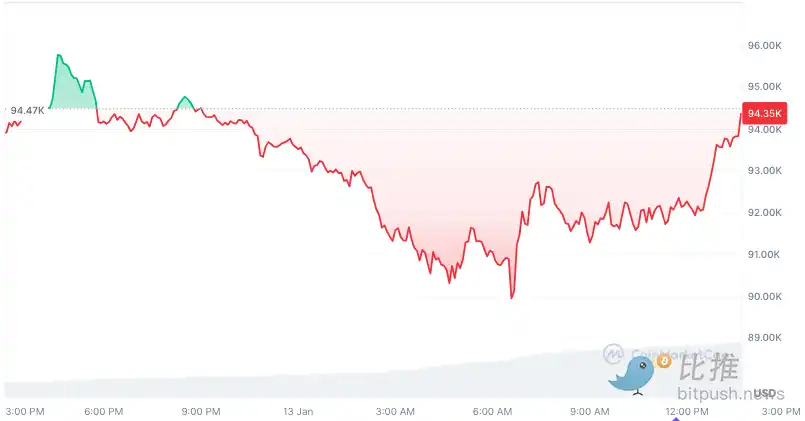
Over the past 24 hours, Bitcoin has staged a V-shaped reversal drama, hitting a low of $90,000, an eight-week low, and bouncing back above $94,000 after the U.S. stock market close, with the market's longs and shorts in a tense situation. Bitcoin's price has dropped over 7% in the past week. Although its market cap continues to hover around $1.864 trillion, its dominance has slightly decreased to 54.2%.
Macroeconomic Factors Lead to Temporary Market Cooling
Experts believe that the pullback that began last week is attributed to optimistic U.S. economic data, including better-than-expected initial jobless claims and labor participation rate. This data has heightened concerns that interest rates may remain high for a longer period than expected.
Chris Chung, CEO and Founder of Titan, stated: "The market seems very concerned that there won't be any more rate cuts in 2025, especially given the incredibly strong jobs report released on Friday. But we also saw a big rally in December, so it's not uncommon for the market to readjust after such a large rally."
He pointed out that with U.S. President-elect Donald Trump set to be inaugurated next week, there is still "further downside risk" in the cryptocurrency market.
Chris Chung said: "Everyone expects Trump to announce regulatory support for cryptocurrency on day one, but he may start with more pressing issues given the Republican control of the House and Senate, along with macro concerns and upcoming token unlocks, this market adjustment may continue into February or even March."
James Butterfill, Head of Research at CoinShares, stated in his fund report: "The honeymoon period after the U.S. election is over, and macroeconomic data once again becomes a key driver of asset prices."
Derivatives Data Shows Sentiment Ranges from Mildly Bullish to Neutral
It is worth noting that the reaction in the Bitcoin derivatives market has been relatively mild.
Firstly, the futures premium is high, as Bitcoin futures contracts typically trade at a premium to the spot market, reflecting market optimism about future prices. Data shows that the current annualized premium rate is at 11%, above the 5%-10% neutral range, indicating that market participants overall remain optimistic.
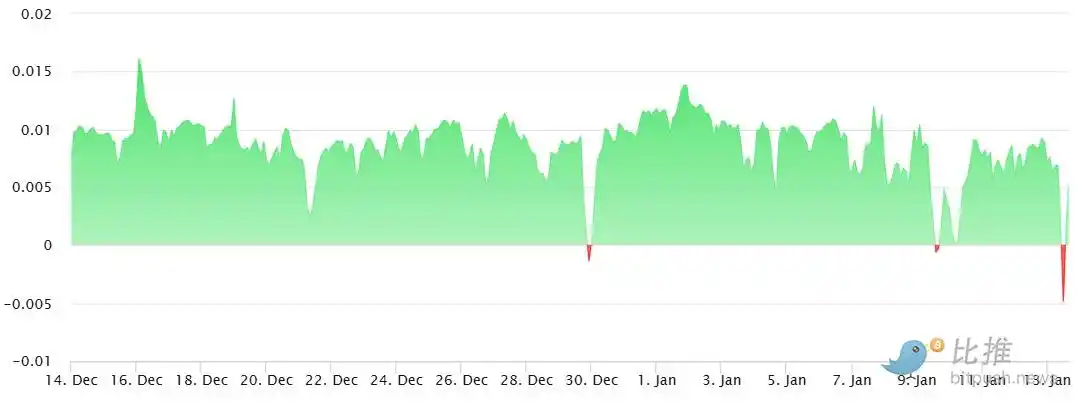
Another indicator is the perpetual contract funding rate (usually reflecting market sentiment). Although on January 13, due to a large number of short positions entering the market, the funding rate briefly turned negative, accompanied by $1.07 billion in long liquidations. However, it quickly rebounded to around 0.5% monthly rate, showing that the market did not exhibit sustained bearish sentiment.
CME Gap Pressure, Will It Be Filled?
Analysts say there is a gap between $88,500 and $77,500 on the CME chart. When there is a difference in the Bitcoin futures price between the close of one trading day and the open of the next trading day, a CME gap occurs, which usually causes Bitcoin to tend to return to a certain level. If Bitcoin faces a downward correction, this gap represents a potential bearish target.
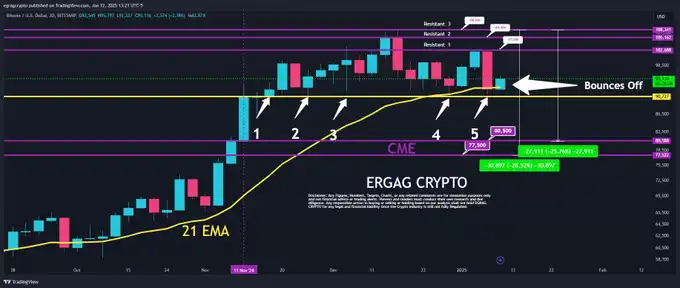
Analysts believe that given Bitcoin's current price of around $94,000, a drop from this level could lead to a significant pullback, potentially resulting in a decline of up to 18% to fill this CME gap.
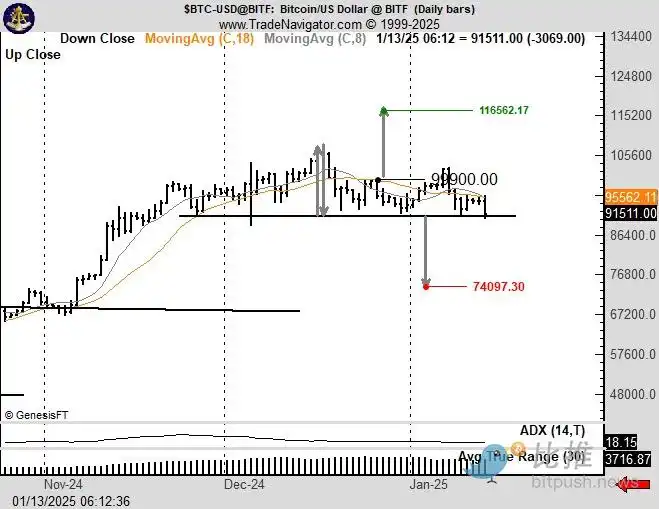
In addition to the CME gap, veteran market analysts like Peter Brandt also point out a potential bearish signal on the Bitcoin daily chart. Brandt suggests that a head and shoulders pattern could form, which may indicate that the Bitcoin price could fall to $73,000. However, Brandt also warns against relying too heavily on this chart as BTC's high volatility often leads to changes in chart patterns.
Therefore, Bitcoin's current trend is influenced by multiple complex factors. While the derivatives market remains relatively calm, the presence of the CME futures market gap, a potential head and shoulders pattern, and key support levels increase the risk of a price downturn. If Bitcoin continues to face pressure, the market will closely monitor whether it will fill the CME gap, which could trigger significant market volatility.
You may also like

Why is a16z Crypto raising another $2.2 billion to heavily invest in Web3?

Polymarket Underlying Algorithm Explained

What do projects born in the crypto bear market do?

a16z founder's Stanford lecture: Whenever Wall Street and Silicon Valley have different ideas, it's Wall Street that ends up being wrong

Michael Saylor: After three consecutive quarters of losses, Strategy will sell Bitcoin to pay dividends

The toll station at Hormuz and the RMB that cannot be bought

Interview with Coinbase Institutional's Strategic Head: The Institutionalization of Crypto Reaches a Critical Point

Dialogue with Agora CEO Nick: The battle for stablecoin licenses has just begun

Morning Report | a16z Crypto completes $2.2 billion fundraising for its fifth fund; Bullish invests $4.2 billion to acquire share transfer agency Equiniti; PayPal's Q1 performance exceeds expectations

a16z Crypto: What We See Behind the $2.2 Billion New Fund
Web3 is dead, Web2+3 should rise
Stablecoins and Latin American Remittances: The Misunderstood $174 Billion Market

The arrival of the Web 3.0 era: A review of Hong Kong court rulings on digital assets

Track Markets At a Glance: New WEEX Price Widgets for iOS & Android
To streamline your market data access, WEEX has officially launched "Market Watchlist" desktop widgets

The billion-dollar lesson: The focus of DeFi security is shifting from code to operational governance
A Brief Analysis of Stablecoin Licenses and On-Chain Funding
BVNK Founder: Three Stages of Stablecoin Development
The truth about Trump's son's Bitcoin game: he made a staggering $100 million while retail investors lost $500 million
Why is a16z Crypto raising another $2.2 billion to heavily invest in Web3?
Polymarket Underlying Algorithm Explained
What do projects born in the crypto bear market do?
a16z founder's Stanford lecture: Whenever Wall Street and Silicon Valley have different ideas, it's Wall Street that ends up being wrong
Michael Saylor: After three consecutive quarters of losses, Strategy will sell Bitcoin to pay dividends
The toll station at Hormuz and the RMB that cannot be bought


